


Industry News
0102030405

How a Singapore Shipyard Solved the Tropical High-Humidity Sealing Challenge: The Art of Precise Material Matching for EPDM and Neoprene Rubber Sheets
2026-11-09
In equatorial waters characterized by high temperatures, high humidity, and intense UV radiation, rubber seals for marine engineering and port facilities face severe challenges. When conducting equipment maintenance, many enterprises often fall into a co...
view
detail

Heavy-Duty Spring-Loaded Rotary Shaft Seals: Why "Rubber Compound" Alone Does Not Prevent High-Speed Lip Burn
2026-11-06
A gearbox manufacturer experienced repeated seal failures on a high-speed input shaft running at 3,600 RPM with a shaft diameter of 45 mm. The calculated surface speed was 8.5 m/s—well within the 12 m/s limit for NBR. Yet the seals bu...
view
detail

ChuncoTech Rubber Launches Global Distributor Recruitment Program for Developed Markets
2026-10-20
Wuxi, China — Wuxi ChuncoTech Rubber, a manufacturer and exporter of engineered rubber products, today announced the launch of its international distributor and agent recruitment program, targeting established partners across Europe, North America,...
view
detail

Vibration Isolation Mounts for HVAC Systems: Why "Load Capacity" Alone Does Not Prevent Structure-Borne Noise
2026-11-04
A light commercial building's rooftop air handling unit (AHU) generated 68 dBA in the office space directly below, exceeding the 40 dBA design limit for occupied areas. The vibration isolation mounts selected for the AHU were correc...
view
detail

Pneumatic Rubber Fenders for Ship-to-Ship Operations: Why "Initial Pressure" Determines Energy Absorption and Hull Protection
2026-11-02
A tanker operating ship-to-ship (STS) transfer in open water sustained hull coating damage during a 1.5-knot current and 0.8-metre swell approach. The fenders were correctly sized by diameter and length, but the initial internal pressure had dropped to 0...
view
detail

O-Ring Seal Selection for High-Pressure Hydraulic Systems: Why "Hardness" Alone Does Not Prevent Extrusion Failure
2026-10-30
A hydraulic press operating at 35 MPa experienced repeated O-ring failures at the cylinder end-cap after only 200 hours of service. The O-rings were 90 Shore A NBR—the hardest standard compound available. The failure was not insufficien...
view
detail

Commercial Tire Selection for Mixed Fleets: Why "Load Rating" Does Not Determine Tire Life
2026-10-28
A logistics fleet operating 40 tractor-trailers and 12 site dump trucks standardized on a single heavy-load tire specification across all vehicles. Within 14 months, the highway tractors were showing irregular shoulder wear, while the dump trucks were su...
view
detail

Industrial Rubber Sheet Selection: Why “Hardness” and “Thickness” Do Not Determine Gasket Life
2026-10-26
A petrochemical plant replaced its flange gaskets with 3 mm SBR rubber sheet cut to size, then discovered seepage at the pipe joints within four months. The gasket had compressed to less than 60% of its original thickness, and the flange bolts could not ...
view
detail
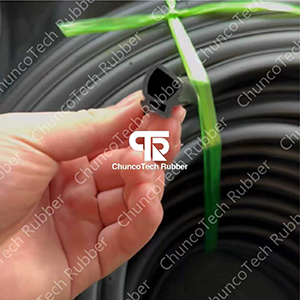
D-Shaped Silicone Seals for Electrical Cabinets and Enclosures: Why Gasket Profile Geometry Determines IP Rating Longevity
2026-10-23
An electrical enclosure rated IP66 at commissioning began failing ingress testing after 18 months in a coastal chemical plant. The failure was not the enclosure—it was the seal profile. The original sponge-rubber seal had compressed permanent...
view
detail

Railway Bridge Rubber Walking Board Failure: Why “Anti-Slip” Is Not Enough for Kazakhstan’s Sub-Zero Winters
2026-10-21
When a Kazakhstan railway operator replaced its bridge maintenance walkway boards after only 18 months, the failure was not surface wear. The boards had delaminated at the internal fabric interlayer, and the base polymer—supplied as EPDM—test...
view
detail