


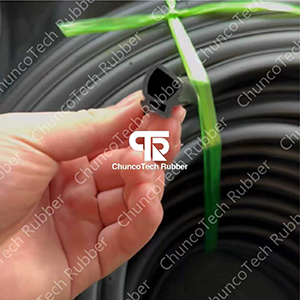

Can Your Dock Fenders Accommodate All Vessel Types? — A Complete Guide to Wuxi ChuncoTech Rubber's W-Type Rubber Fenders
In our previous article, "Why Do Rubber Fenders Fail at the Welds? How Seamless Blow-Molded Fenders Solve the Problem," we explored the causes of weld failure and how seamless blow-molded fenders address this issue. Today, we turn our attention from welding processes to another highly adaptable and widely used fender product — the W-Type rubber fender (W-Type Fender) . If your port handles multiple vessel types — from small tugboats to large bulk carriers, from high-speed catamarans to heavy barges — you've likely asked yourself: Why can't one fender system satisfy all vessel types? Why are some fenders too stiff for small vessels but insufficiently energy-absorbing for large ones? The answers often lie in the fender's cross-sectional design and operating principles.
I. Is Your Port Struggling with "Too Many Vessel Types"?
Operators of multi-purpose terminals, Ro-Ro terminals, Ro-Pax terminals, and general cargo terminals frequently face these challenges:
-
Wide vessel type range: A 500-ton tugboat berths in the morning; a 50,000-ton bulk carrier arrives in the afternoon. The same fender system is "too stiff" for small vessels and "too soft" for large ones.
-
Variable berthing angles: Some vessels (such as Ro-Ro ships and ferries) often berth at large angles, subjecting fenders to shear forces that cause ordinary fenders to tear.
-
Large freeboard variations: The freeboard height of a vessel can differ by several meters between light and loaded conditions. A single row of fenders cannot protect different parts of the hull simultaneously.
-
Frequent fender replacement: Poor adaptability causes certain fender sections to wear out much faster than others, driving up maintenance costs.
-
Aging dock structures: Unable to withstand high-reaction-force fenders, yet requiring berthing capacity upgrades.
These challenges point to one need: a highly adaptable fender — one that absorbs large vessels' massive impact energy while generating low reaction forces on small vessels; one that withstands both head-on impacts and shear forces; one that installs on straight walls and curved quays alike.
At Wuxi ChuncoTech Rubber , we believe: A port's fender system should serve all calling vessels, not just the largest or smallest ones. Our W-Type rubber fender, with its unique "W"-shaped cross-section design, delivers low reaction force, high energy absorption, and excellent shear tolerance — making it the "master key" for multi-vessel-type ports.

II. What Exactly Is a W-Type Rubber Fender? What Secrets Does the "W"-Shaped Cross-Section Hold?
The W-Type rubber fender (W-Type Fender) is named for its cross-sectional shape, which resembles the letter "W" . This seemingly simple geometric design actually embodies sophisticated mechanical engineering:
1. Three "Arches" Working in Harmony
The W-shaped cross-section is essentially three continuous arch structures — one inverted arch in the middle and two upright arches on the sides. When a vessel impacts the fender:
-
First contact occurs at the apex of the middle arch, providing a very soft initial compression force.
-
As compression continues, the side arches gradually engage, causing the reaction force to rise smoothly.
-
At full compression, all three arches work together, delivering maximum energy absorption.
This "progressive" compression characteristic allows the W-Type fender to maintain a smooth force-deflection curve throughout the entire range from small to large deflections.
2. Hyperbolic Contact Surface
The contact surface of a W-Type fender is not a simple plane or arc, but a complex surface with hyperbolic characteristics. This design:
-
Accommodates various berthing angles — even when a vessel berths at a 10-15 degree angle, the fender still experiences uniform force distribution.
-
Reduces local stress concentration, preventing the "point contact" that leads to premature wear.
-
Under shear forces, the W-shaped structure can "twist" rather than "tear," significantly improving shear resistance.
3. Low Reaction Force Characteristics
Compared to D-Type or V-Type fenders of the same dimensions, the W-Type generates 20-30% lower reaction force at the same compression. This means:
-
More "friendly" to small vessels — no excessive rebound or hull damage from high reaction forces.
-
Safer for aging docks — will not exceed the dock's structural load-bearing capacity.
-
For large vessels — sufficient energy absorption can be achieved through greater compression.
III. Where Do W-Type Fenders Perform Best? Core Applications
W-Type rubber fenders are the "best partner" for multi-vessel-type terminals, suitable for the following scenarios:
1. Multi-Purpose Terminals (General Cargo Terminals)
Multi-purpose terminals handle containers, bulk cargo, breakbulk, heavy-lift cargo, and more — resulting in an extremely diverse range of calling vessels. The broad adaptability of W-Type fenders allows terminal operators to serve different vessel types without changing or adjusting the fender system.
2. Ro-Ro and Ro-Pax Terminals
Ro-Ro and Ro-Pax vessels are characterized by: frequent berthing, variable angles, fixed freeboard but widely varying vessel sizes. The shear toleranceand low reaction force characteristics of W-Type fenders make them the ideal choice for these terminals.
3. Ferry Terminals
Ferries berth dozens of times per day, requiring fenders with extremely high fatigue life. The progressive compression characteristic of W-Type fenders ensures that each berthing impact is absorbed evenly, preventing accelerated aging from "hard-on-hard" impacts.
4. Fishing Ports and Marinas
Vessels in fishing ports and marinas are small and berth slowly, but they have high sensitivity to fender feel — fenders that are too stiff can damage small fiberglass hulls. The soft initial compression characteristic of W-Type fenders provides "gentle" protection for small vessels.
5. Dry Docks and Repair Berths
When vessels enter and exit dry docks, sliding contact is often required. The hyperbolic surface design of W-Type fenders reduces friction resistance, while their low reaction force characteristic minimizes damage to hull coatings.

IV. Beyond Just Shape: Our W-Type Fender's "Four Core Technologies"
The W-shaped cross-section is the foundation, but what makes Wuxi ChuncoTech Rubber 's W-Type fenders truly exceptional are the following four core technologies:
1. Specialized Rubber Formulation: High Tear Strength, Aging Resistance, Low Heat Generation
W-Type fenders experience complex tensile, compressive, and shear stresses during operation. Our rubber formulation is specially optimized:
-
High tear strength: Specialty reinforcing fillers achieve tear strength exceeding 50 kN/m , far exceeding the 30-35 kN/m of ordinary fenders.
-
Low dynamic heat generation: An optimized curing system reduces internal friction between rubber molecular chains, generating less heat during repeated compression and delaying thermal aging.
-
Excellent ozone resistance: High-efficiency antiozonants provide 72 hours without cracks at 50 pphm ozone concentration.
2. Precise Hardness Control: Balancing Softness and Stiffness
W-Type fender performance is highly dependent on rubber hardness. We maintain strict tolerances of ±3 Shore A (industry standard is typically ±5). For different sections of the same W-Type fender, we can even achieve graduated hardness — slightly softer on the contact surface (improving adaptability) and slightly harder at the base (ensuring secure installation).
3. Continuous Extrusion and Vulcanization Process: Unlimited Length, No Quality Breaks
Unlike compression-molded fenders that require molds, our W-Type fenders are manufactured using a continuous extrusion + microwave vulcanization process:
-
Unlimited length: We can produce fenders in any continuous length required for your terminal, reducing seams and joints.
-
Excellent cross-sectional consistency: In-line laser diameter gauges monitor in real-time, ensuring that the cross-sectional dimensions of the entire fender remain within tolerance.
-
No mold flash: Smooth surface finish requires no post-processing and allows tighter fit during installation.
4. Installation System Optimization: Anti-Pull-Out, Easy Replacement
W-Type fenders are typically installed using clamp-plate mounting or through-bolt mounting. We provide:
-
Stainless steel clamp plate kits: Corrosion-resistant in seawater, remaining rust-free for over 10 years.
-
Cast-in anchor bolt positioning templates: Ensuring precise bolt placement and uniform fender force distribution after installation.
-
Replaceable wear indicator strips: Colored indicator layers embedded in the fender surface become visible when wear reaches a certain depth, alerting maintenance personnel that replacement is needed.
V. Real Test Data Comparison: W-Type vs D-Type vs V-Type
We conducted comparative testing of Wuxi ChuncoTech Rubber 's W-Type fender against D-Type and V-Type fenders of the same external dimensions:
Energy absorption efficiency (at 50% compression) : The W-Type fender absorbed 25% more energy than the D-Type and 15% more than the V-Type. This means that for the same physical size, the W-Type fender can protect larger vessels.
Peak reaction force (at 50% compression) : The W-Type fender generated 20% lower reaction force than the D-Type and 10% lower than the V-Type. This is particularly important for aging docks and lightweight structures.
Shear tolerance (15-degree angular compression) : Under 15-degree angular compression, the D-Type fender lost 40% of its effective energy absorption; the V-Type lost 30% ; while the W-Type lost only 15% . The W-Type remains highly effective even during angled berthing.
Fatigue life (50% compression, 1 million cycles) : The D-Type fender developed cracks after 300,000 cycles ; the V-Type after 500,000 cycles ; the W-Type remained intact after 1 million cycles — 3 times longer before crack initiation.
Initial compression force (at 10% compression) : The D-Type required 80 kN/mto achieve 10% compression; the V-Type required 60 kN/m ; the W-Type required only 40 kN/m . This means small vessels feel the least "rebound force" when berthing against W-Type fenders, resulting in the softest berthing experience.
Data source: Joint test report from Wuxi ChuncoTech Rubber internal laboratory and third-party testing institute
VI. Real Customer Story: How a Multi-Purpose Terminal Achieved "Set It and Forget It" with W-Type Fenders
Background: A multi-purpose terminal along the Yangtze River with an annual throughput of 5 million tons. Calling vessel types included: 5,000-ton bulk carriers, 1,000-ton breakbulk vessels, 3,000-ton container ships, and occasional 10,000-ton ocean-going vessels. The existing fender system used D-Type fenders with several problems: (1) small vessels felt a "hard-on-hard" impact with noticeable hull vibration; (2) large vessels experienced insufficient energy absorption, causing dock stress exceedances; (3) frequent fender replacement — every 2-3 years on average.
Solution: The engineering team at Wuxi ChuncoTech Rubber recommended W300 rubber fenders (width 300mm, projection 150mm) installed along the entire quay length — 800 linear meters total. Clamp-plate mounting was used with stainless steel plates and cast-in anchors.
Results: After 4 years of operation, all vessel types reported significantly improved berthing experiences. Small vessel captains said, "Berthing is much softer now — the crew no longer tenses up." Large vessel pilots reported, "Energy absorption is sufficient — we feel very safe." Terminal maintenance records showed zero replacements, zero repairs, zero complaints over 4 years. The terminal operations manager said: "Before, we replaced fenders every two years. Now, after four years, they still look like new. The extra investment in W-Type fenders paid for itself within two years."
VII. W-Type vs Blow-Molded Fenders: Which One Should You Choose?
Continuing from our previous article on blow-molded fenders, here is a comparison of their applicable scenarios:
Suitable vessel types: W-Type fenders excel with multiple vessel types, especially small to medium vessels. Seamless blow-molded fenders are better suited for large vessels with single vessel type profiles.
Berthing angle tolerance: W-Type fenders tolerate angled berthing well (15-20 degrees). Blow-molded fenders are designed primarily for head-on berthing.
Installation method: W-Type fenders are typically installed continuously along the quay. Blow-molded fenders use discrete (point-type) installation.
Maintenance cost: W-Type fenders offer very low maintenance costs with 10+ years of service life. Blow-molded fenders also offer low maintenance costs with 5-10 years of service life.
Initial investment: W-Type fenders require moderate initial investment. Blow-molded fenders require higher initial investment.
Best application scenarios: W-Type fenders are ideal for multi-purpose terminals and Ro-Ro terminals. Blow-molded fenders are ideal for large container terminals and LNG terminals.
Simple advice: If your terminal serves multiple vessel types (especially with a significant proportion of small to medium vessels), or if berthing angles vary frequently, the W-Type rubber fender is the better choice. If your terminal primarily serves large, single vessel types with extremely high energy absorption requirements, seamless blow-molded fenders may be more suitable.
VIII. Your Port Deserves a "Versatile" Fender System
Does your terminal need to accommodate multiple vessel types? Are you looking for a "versatile" fender that is gentle on small vessels yet powerful for large ones? Is your maintenance team tired of frequently replacing worn-out fenders?
It's time to choose a truly "versatile" fender for your port. Wuxi ChuncoTech Rubber 's W-Type rubber fenders — with their unique W-shaped cross-section, progressive compression characteristics, and excellent shear tolerance — are the "master key" for multi-vessel-type terminals.
Take action now:
-
Visit our website https://www.chuncotechrubber.com to download our "W-Type Rubber Fender Product Selection Guide and Installation Manual."
-
Contact our marine fender engineering team — provide your terminal parameters, list of calling vessel types, and berthing frequency. We will deliver free fender selection recommendations and layout plans within 48 hours.
-
Request free samples or detailed test reports — see the superior performance of W-Type fenders for yourself.
Wuxi ChuncoTech Rubber — Protecting the berthing safety of every vessel type with W-shaped intelligence.