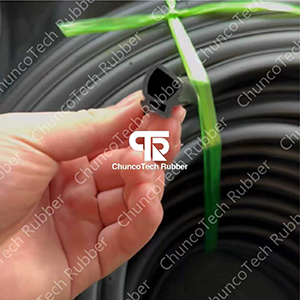
In our last article, “Why Do Railway Rubber Pads Fail Prematurely? How Wuxi ChuncoTech Rubber Solves the Problem”, we explored how rubber pads protect railway tracks from heavy loads. Today, we shift from rail to road—to a sophisticated rubber component that has revolutionized vehicle ride comfort: the air spring. If you have ever asked “how does air suspension work” or “what is inside an air spring,” you are not alone. Air springs have moved from luxury vehicles to mainstream passenger cars, but their internal construction remains a mystery to many. At Wuxi ChuncoTech Rubber, we manufacture high-durability rubber air spring bellows—the critical rubber component that makes air suspension possible. Here is what you need to know about air spring design, types, and the rubber technology that makes them work.
What Is an Air Spring? The Rubber Heart of Air Suspension
An air spring is the core elastic component of an automotive air suspension system. Instead of a traditional steel coil spring, it uses compressed air inside a rubber bellows to support the vehicle’s weight. By adjusting the air pressure, the system can change spring stiffness and ride height in real time—soft for comfort, firm for handling, raised for rough roads, lowered for highway efficiency.
Why rubber? The air spring bellows must flex millions of times without leaking, cracking, or losing shape. It is made from rubber-cord composite materials—typically multiple layers of rubber and high-strength fabric or steel cord. The rubber provides airtightness and weather resistance; the cord carries the tensile load.
How Air Springs Work: The Science of Variable Stiffness
An air spring works together with a height sensor, air compressor, reservoir tank, and electronic control unit (ECU). Here is the sequence:
-
Height sensor continuously monitors the distance between the vehicle body and the wheel.
-
When the vehicle is loaded with cargo or passengers, the body sinks. The sensor detects this.
-
ECU sends a signal to the air compressor.
-
Compressor pumps air into the air spring bellows through the air inlet.
-
Increased air pressure raises the body back to the target height—and increases spring stiffness to handle the extra load.
-
When the vehicle is unloaded, the ECU vents air, lowering the body and softening the spring.
The result: A vehicle that rides smoothly whether empty or fully loaded, corners flat, and can raise its body for off-road obstacles.

Why Rubber Quality Is Critical: The Bellows Challenge
The rubber bellows is the most stressed component in an air spring. It must:
-
Withstand millions of flex cycles (each bump compresses the spring)
-
Hold pressure without leaking (typical operating pressure: 5–10 bar)
-
Resist ozone, UV, and weather (mounted under the vehicle, exposed to the elements)
-
Maintain flexibility from -40°C to +80°C
-
Withstand occasional overloads (potholes, curbs)
Cheap bellows fail: Poor-quality rubber cracks, cord layers separate, or the bellows develops pinhole leaks. The result: the vehicle sits on its bump stops, the ride becomes harsh, and replacement costs are high.
How Wuxi ChuncoTech Rubber ensures bellows quality: We use high-tenacity cord reinforcement (nylon, polyester, or steel depending on pressure requirements) with optimized cord angles for uniform load distribution. Our low-compression-set rubber compounds maintain shape and sealing force over millions of cycles. Every bellows is pressure-tested before shipment.
Types of Air Springs: Single-Chamber, Dual-Chamber, and Triple-Chamber
Air springs have evolved rapidly. The simplest and most common is the single-chamber air spring—one air volume, one stiffness range. It is cost-effective and reliable but offers limited stiffness adjustment.
The dual-chamber air spring adds an internal partition, creating two air volumes. Valves can connect or isolate the chambers. When only one chamber is active, the spring is soft. When both chambers are connected, the spring is firm. This gives two distinct stiffness levels—comfort or sport—at the push of a button.
The triple-chamber air spring adds a third chamber, offering five stiffness levels. It provides the widest range from very soft (luxury ride) to very firm (track handling). However, it is more complex, heavier, and more expensive.
Wuxi ChuncoTech Rubber manufactures bellows for all three types. We work with air suspension system integrators to develop custom bellows for specific vehicle platforms.
Open vs. Closed Air Supply Systems
Early air suspension systems used open systems: air was drawn from the atmosphere, compressed, and vented back to the atmosphere. Open systems are simple but noisy and inefficient.
Modern systems use closed (sealed) systems: air is circulated within a closed loop. A small compressor transfers air between a reservoir tank and the air springs. Closed systems are quieter, more energy-efficient, and less affected by external air temperature or humidity.
Wuxi ChuncoTech Rubber bellows are compatible with both open and closed systems. Our rubber compounds are formulated for the specific pressure cycles of each architecture.
Real-World Result: Chinese EV Manufacturer Extends Air Spring Life
A Chinese electric vehicle manufacturer was experiencing air spring bellows failures at 80,000 km—below their 150,000 km target. The failures were caused by cord separation and ozone cracking. They switched to Wuxi ChuncoTech Rubber bellows with optimized cord construction and ozone-resistant EPDM compound. After 200,000 km of testing, no failures. The manufacturer now specifies our bellows for their luxury EV platform.
The Future of Air Springs: Lightweight, Durable, Affordable
As air suspension moves from luxury vehicles to mass-market cars (starting at the $25,000–30,000 price point), the demands on rubber bellows increase:
-
Lightweight: Every gram matters for EV range.
-
Durable: Mainstream buyers expect 150,000+ km without suspension repairs.
-
Affordable: High quality at lower cost.
Wuxi ChuncoTech Rubber is ready. We are developing next-generation bellows with:
-
Thinner, stronger cord reinforcement (reduces weight while maintaining strength)
-
Advanced rubber compounds (longer life at lower cost)
-
Automated manufacturing (consistent quality at scale)
Your Air Spring Bellows Partner
Whether you are an air suspension system integrator, a vehicle manufacturer, or a replacement parts distributor, Wuxi ChuncoTech Rubber has the expertise and manufacturing capability to supply high-quality air spring bellows for your application.
We offer:
-
Custom bellows design for specific vehicle platforms
-
Multiple cord reinforcement options (nylon, polyester, steel)
-
Wide material selection (NR, EPDM, CR, NBR)
-
Pressure testing (every bellows verified before shipment)
-
Durability validation (million-cycle fatigue testing available)
Visit our website at https://www.chuncotechrubber.com/ to request an air spring bellows consultation or to order samples. Let us help you raise your suspension—and your quality—to new heights.