


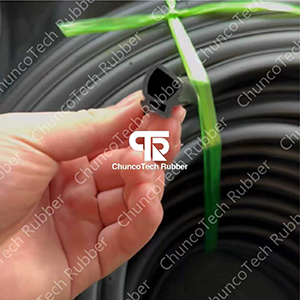


How to Choose the Correct Rubber Tracks for Excavators and Construction Equipment?

Quick Answer
Choosing the correct rubber tracks requires matching four critical specifications to your machine and application: track size (width × pitch × number of links), tread pattern (for terrain type), rubber compound quality (for durability), and internal reinforcement structure (steel cord configuration). The most common ordering mistake is selecting tracks by machine model alone without verifying actual dimensions stamped on the existing track. Rubber tracks typically deliver 1,200–2,000 hours of service life when properly matched and maintained, but can fail in under 400 hours with incorrect tension or severe terrain mismatch.
Key Takeaways
●Track dimensions follow a standard three-part format: width (mm) × number of links × pitch (mm), stamped on the track’s inner surface.
●Rubber tracks are the default for mini excavators under 10,000 lbs: they protect surfaces, reduce noise, and offer sufficient durability for light-to-medium applications.
●Tread pattern should match your primary terrain: zig-zag for mixed conditions, straight-bar for soft ground, block pattern for hard surfaces.
●Proper tension is 10–20mm sag at the center roller: incorrect tension is the leading cause of premature failure.
●Quality compounds use 70% natural rubber: high natural rubber content resists cuts, tears, and abrasion far better than high-synthetic or recycled compounds.
1. Understanding What You Are Actually Ordering
Rubber tracks are composite engineered structures, not simple rubber loops. A quality rubber track consists of three functional layers: outer rubber tread (provides traction and surface protection), embedded steel cords (continuous cables that bear the machine‘s tensile load), and forged steel guide teeth (metal cores that engage with sprockets and prevent derailment).
1.1 The Three Dimensions That Define a Track
Every rubber track is defined by three measurements that must match your machine‘s undercarriage exactly:
| Dimension | Format Example | What It Measures | Why It Matters |
|---|---|---|---|
| Width | 300 mm | Across the tread surface | Affects flotation and ground pressure |
| Number of Links | 52.5 | Metal cores around the loop | Determines total track length |
| Pitch | 52.5P | Center-to-center distance between links | Must match sprocket tooth spacing |
A standard size indication appears as: 300 × 52.5 × 82 (width × pitch × number of links). If any of these three numbers differs from your machine‘s specification, the track will not function correctly.
1.2 Carcass Construction: The Steel Cord System
The internal steel cords are the structural backbone of a rubber track. Quality manufacturers use continuous steel cable technology with high shear and elongation resistance. These cords provide uniform tension across the entire track and are coated to improve bonding with the rubber compound, preventing detachment and corrosion.
Lower-quality tracks may use discontinuous or poorly coated cords, which lead to internal separation, carcass puncture, and catastrophic failure under load.
2. The Four-Factor Selection Framework
Choosing the correct rubber track requires evaluating four interdependent factors. Failure to address any one of these will compromise track performance and lifespan.
2.1 Factor One: Machine Compatibility and Size Verification
The track must match your machine’s undercarriage geometry, not just the OEM part number. Machine weight, sprocket configuration, and roller type all influence track selection.
Step-by-step size verification:
1.Locate the stamp on your existing track: The size indication (e.g., 300 × 52.5 × 82) is typically stamped on the inner surface of the track.
2.If the stamp is worn, measure manually: Measure the width across the tread, count the number of metal links around the loop, and measure the pitch (distance from center of one link to the center of the next).
3.Check the guide system dimensions: Measure the internal and external widths of the guide trough that engages with rollers and sprockets.
4.Verify roller type: Conventional tracks are designed for rubber-only undercarriages; interchangeable tracks fit machines designed for both steel and rubber tracks.
Critical rule: Mini excavators under 10,000 lbs typically use rubber tracks. Larger machines (over 10,000 lbs) often use steel tracks for rocky or abrasive terrain. Using rubber tracks on machines beyond their rated capacity causes rapid carcass failure.
2.2 Factor Two: Tread Pattern Selection
Tread pattern determines traction characteristics, ground disturbance, and operating surface compatibility. Most rubber track manufacturers offer multiple patterns optimized for different applications.
| Pattern Type | Visual Characteristic | Best Applications | Surface Impact |
|---|---|---|---|
| Straight-Bar | Parallel bars across width | Soft, muddy, sandy terrain | Minimal disturbance; high flotation |
| Zig-Zag (Z-Pattern) | Alternating angled lugs | Mixed terrain, construction sites | Moderate; versatile traction |
| Block/Lug | Prominent separate blocks | Hard surfaces, asphalt, concrete | Low marking; smooth ride |
| Turf-Friendly | Closely spaced shallow lugs | Landscaping, lawns, golf courses | Minimal; protects delicate surfaces |
| Aggressive/Deep Lug | Tall, widely spaced lugs | Muddy, steep, off-road conditions | Higher disturbance; maximum traction |
Selection guidance by primary terrain:
●Asphalt, concrete, finished surfaces: Block or turf-friendly pattern
●Soft soil, mud, sand: Straight-bar or wide zig-zag pattern
●Rocky, uneven, mixed: Aggressive zig-zag with reinforced shoulder
●Agricultural fields: Turf-friendly or zig-zag depending on crop and soil conditions
2.3 Factor Three: Rubber Compound and Durability
The rubber compound formulation is the single strongest predictor of track lifespan. Quality tracks use approximately 70% natural rubber and 30% synthetic rubber, which provides maximum resistance to cuts, tears, and abrasion.
Natural rubber offers superior elasticity, tear resistance, and low-temperature flexibility compared to synthetic alternatives. High-synthetic or recycled rubber compounds may reduce manufacturing cost but dramatically shorten service life, particularly in abrasive or extreme-temperature environments.
Durability indicators to request from suppliers:
●Material Test Reports (MTRs) verifying compound composition and tensile strength
●Abrasion resistance data (ASTM G65 or equivalent)
●Steel cord specifications: continuous vs. discontinuous, coating type, shear strength
●Tensile strength ratings for the specific carcass construction
2.4 Factor Four: Operating Environment and Temperature
Rubber tracks perform optimally within a defined temperature range of -25°C to +55°C (-13°F to +131°F). Operating outside this range accelerates compound degradation.
Environmental factors that demand special consideration:
●High-temperature environments (above 55°C): Standard compounds soften and wear rapidly; heat-resistant formulations are required.
●Freezing conditions (below -25°C): Standard rubber becomes brittle and prone to cracking; low-temperature compounds maintain flexibility.
●Chemical exposure: Oil, hydraulic fluid, and salt accelerate rubber degradation. Tracks should be cleaned promptly after contact.
●Sharp debris: Rebar, broken concrete, and jagged rock cause carcass penetration. Reinforced models with additional breaker layers are recommended.
3. Maintenance Practices That Determine Actual Lifespan
Proper maintenance can extend rubber track life from the typical 1,200–1,600 hours to 2,000 hours or more, while neglect can reduce lifespan to under 400 hours.
3.1 Tension Adjustment: The Single Most Important Maintenance Task
Correct tension is 10–20mm of sag measured at the center track roller with the machine in a lifted position.
●Too loose: The track can derail from the sprocket, especially during turns or on uneven ground.
●Too tight: Excessive tension accelerates wear on the sprocket, idler, and track’s internal steel cords.
Tension should be checked daily during active operation and adjusted according to the manufacturer‘s specification.
3.2 Operating Practices to Avoid
Avoiding destructive operating habits prevents the majority of premature failures:
●Sharp turns on abrasive surfaces: causes rapid edge wear and lug damage
●Forced climbing over large obstacles: concentrates stress on individual links
●Operating with packed debris: trapped rocks or mud between track and undercarriage accelerate internal wear
●Neglecting undercarriage component wear: worn sprockets and idlers destroy new tracks rapidly
3.3 Inspection Schedule
Establish daily, monthly, and quarterly inspection routines:
| Frequency | Inspection Items |
|---|---|
| Daily | Tension check; visible damage (cuts, cracks); debris removal |
| Weekly | Sprocket tooth wear; idler and roller condition; track alignment |
| Monthly | Tread depth measurement; deep cut inspection (>10cm penetration requires replacement) |
| Quarterly | Full undercarriage assessment; replace worn sprockets/rollers before installing new tracks |
4. Cost-Per-Hour Analysis: Why Cheaper Tracks Cost More
A cheap rubber track that fails in 400 hours costs 3–4× more per operating hour than a quality track that delivers 1,500+ hours. The purchase price differential between low-grade and premium tracks is typically 20–40%, but the lifespan differential is often 200–300%.
4.1 Quality Comparison Framework
| Factor | Economy Track | Premium Track | Impact on Cost-Per-Hour |
|---|---|---|---|
| Rubber compound | High synthetic, fillers | 70% natural rubber | Economy wears 2–3× faster |
| Steel cord | Discontinuous, thin | Continuous, high-tensile | Premium resists carcass failure |
| Link design | Simple, thin metal | Forged steel, extended width | Premium distributes load, prevents derailment |
| Warranty | 6–12 months limited | 12–24 months / 1,500–2,500 hours | Premium signals manufacturer confidence |
4.2 Warranty as a Quality Signal
A manufacturer offering a 1,500-hour or 24-month warranty is signaling confidence in their compound and construction quality. Camso‘s SD rubber tracks carry a 1,500-hour non-prorated warranty, compared to 1,250-hour coverage on standard tracks.
5. Pre-Order Verification Checklist
Before issuing a purchase order for rubber tracks, confirm the following:
Machine and Size Verification
Machine make, model, and year documented
Track dimensions verified: width × pitch × number of links
Guide system dimensions measured (internal/external width, height)
Roller type identified (conventional or interchangeable)
Application Matching
Primary terrain type identified (soft, hard, mixed, rocky)
Tread pattern selected for terrain requirements
Operating temperature range confirmed within -25°C to +55°C
Any chemical exposure or extreme conditions noted
Quality Verification
Rubber compound composition confirmed (natural rubber content)
Steel cord construction details obtained (continuous, coating type)
Material Test Reports or abrasion data requested
Warranty terms reviewed (coverage hours and duration)
Commercial
Tracks ordered in pairs (replacing only one causes alignment issues)
Undercarriage components inspected for wear before installation
Installation and tension adjustment instructions provided
FAQ
1. How do I know what size rubber track my mini excavator needs?
Check the stamp on your existing track‘s inner surface—it follows the format: width (mm) × pitch (mm) × number of links. If the stamp is worn, measure the width across the tread, count the metal links around the loop, and measure the pitch (center-to-center distance between links). The track size must match all three dimensions exactly for proper fit.
2. What is the average lifespan of rubber tracks for construction equipment?
Quality rubber tracks typically deliver 1,200–1,600 hours of service life under normal conditions, with properly maintained tracks reaching 2,000 hours. Neglected tracks or severe terrain can reduce lifespan to under 400 hours. Tracks should be replaced in pairs to maintain proper alignment and undercarriage wear patterns.
3. How tight should my rubber tracks be?
Maintain 10–20mm of sag at the center track roller with the machine lifted. Too loose causes derailment; too tight accelerates wear on sprockets, idlers, and internal steel cords. Check tension daily during active operation.
4. Can I use rubber tracks on rocky or abrasive terrain?
Rubber tracks can operate on rocky terrain but wear significantly faster than on softer surfaces. For frequent operation on sharp, abrasive materials, choose tracks with reinforced shoulder compounds and aggressive tread patterns. Steel tracks are more cost-effective for continuous rocky terrain operations.
5. What is the difference between conventional and interchangeable rubber tracks?
Conventional rubber tracks are designed for undercarriages that accept only rubber tracks. Interchangeable tracks fit machines with undercarriages designed for both steel and rubber tracks. The guide system dimensions differ between these two types, so verifying roller type is essential before ordering.
6. Why do rubber tracks fail before reaching their rated lifespan?
The most common causes of premature failure are improper tension (either too loose or too tight), operating on severely abrasive terrain beyond the track‘s design intent, worn or damaged undercarriage components (sprockets, idlers, rollers) destroying the track from the inside, and chemical exposure without prompt cleaning.
7. How do I store rubber tracks that are not currently in use?
Store tracks on their side in a relaxed position in a cool, dry environment away from direct sunlight. If tracks remain installed on a machine that is not in use, operate the machine for five minutes every two weeks to maintain rubber flexibility and prevent deformation.