




How to Choose the Right Rubber Manufacturing Process for Your Project?
In our previous article, "Is Your Specialty Rubber Curing System Costing You Compliance and Performance? Wuxi ChuncoTech Rubber's Guide to Smart Selection," we explored how curing systems critically influence the final properties of rubber products. However, even the most carefully selected material formulation cannot deliver its intended performance if the manufacturing process does not align with the product's design requirements. Selecting the optimal rubber component manufacturing process is another strategic engineering decision, following material selection, that directly determines geometric precision, structural integrity, production costs, and long-term service reliability.
Whether you are developing high-durability brake chamber diaphragms for automotive braking systems, precision seals for industrial machinery, or weather-resistant protective components for marine and railway equipment, understanding the fundamental differences between molded rubber, extruded rubber, and die-cut rubber is essential for project success.Wuxi ChuncoTech Rubber design to precision manufacturing—helping customers meet performance targets while optimizing costs.

Addressing the Real Challenges Rubber Buyers Face
Let's be honest—specifying rubber parts is rarely straightforward. Many engineers and procurement professionals wrestle with the same persistent headaches. Perhaps you've received parts that looked fine in the sample batch, only to find the next shipment's dimensions shifted, flash grew, and assemblies started leaking. Or maybe you're caught between leadership demanding cost reductions and production lines that simply cannot afford downtime from a failed seal.
These aren't just hypothetical concerns. Research shows that quality-related problems remain a major source of customer complaints in rubber manufacturing. One of the most common challenges? Additives like sulfur and zinc oxide not dispersing evenly in the compound, generating localized hard spots that attract mechanical and thermal stress—causing the material to degrade prematurely. The kicker? Flaws as small as the width of a human hair can significantly impact the lifespan of critical components.
Then there's the dimensional puzzle. Many buyers copy metal tolerances onto rubber drawings, forgetting that rubber behaves differently—it shrinks, relaxes, and changes with time and temperature. And when a rush order lands—whether from a machine breakdown, an urgent replacement, or an unexpected quality failure from a previous supplier—the pressure intensifies.
Understanding the Core Rubber Manufacturing Processes
Rubber components can be produced through three primary manufacturing methods, each offering distinct advantages and applicable boundaries. The choice of process influences not only production costs and lead times but also the final part's geometry, dimensional accuracy, and functional performance in demanding service environments.
Molded rubber involves shaping raw rubber compounds inside a closed mold under heat and pressure, allowing for the creation of intricate three-dimensional geometries, tight tolerances, and integrated features such as rubber-to-metal bonding and encapsulated inserts. This process is ideal for components requiring precise engineering and structural integrity, including vibration isolation mounts, bushings, grommets, seals, diaphragms, and composite parts with metal inserts. Advanced molding techniques such as compression molding, transfer molding, and injection molding offer flexibility for both low-volume prototyping and high-volume production, with injection molding providing exceptional repeatability and efficiency for complex parts at scale.
However, one challenge with molded parts is managing rubber shrinkage. Parts always come out of the mold smaller than the cavity that produced them. Factors like polymer type, filler characteristics, cure system, and even part geometry all influence how much shrinkage you'll see. For tight-tolerance parts, even changing the cure system can affect final size. This is where working with an experienced partner who understands these variables becomes invaluable.
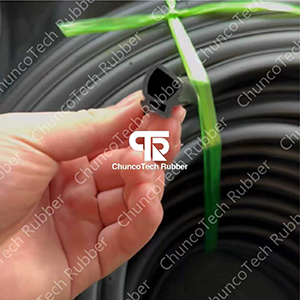
Extruded rubber is a continuous process where rubber compound is forced through a shaped die to produce long, uniform profiles with consistent cross-sections. This method is highly cost-effective for applications requiring continuous lengths of consistent geometry, such as weather stripping, tubing, edge trims, glazing channels, and custom sealing profiles. Extrusion excels in producing flexible, durable profiles with excellent uniformity along their length, making it a preferred solution for sealing systems and protective edging in automotive, construction, and industrial applications.
A common frustration with extrusion? Achieving tight tolerances on complex profiles can be difficult, and die design itself is critical. The shape and design of the extrusion die directly affect the appearance and quality of the final product. Poor die design can lead to deformation issues upon extrusion. Recent innovations, such as 3D-printed extrusion dies using advanced photopolymers, are starting to offer faster, more flexible tooling solutions.
Die-cut rubber involves cutting flat shapes from rubber sheets using steel rule dies or CNC systems, offering a fast and economical solution for simple to moderately complex parts such as gaskets, pads, mats, and flat sealing washers. This process is well-suited for high-volume orders of flat components where consistent thickness and rapid turnaround are priorities. However, die-cutting has its own set of challenges. Cutting compression is a real issue, especially with thick, soft, or low-durometer materials. The blade squishes the material, leaving a strange curvature or concave edge. This makes achieving very tight tolerances more difficult, which is why flat-bed die cutting is often recommended over rotary processes for thicker materials.
Key Advantages of Wuxi ChuncoTech Rubber's Manufacturing Capabilities
Wuxi ChuncoTech Rubber leverages a tightly coordinated production network to deliver superior rubber components across diverse industries. Our Wuxi factory, a modern manufacturing base spanning 11,880 square meters, employs over 150 technical professionals and operates more than 100 sets of advanced production equipment to ensure on-time delivery and consistent quality. We maintain rigorous quality management systems, including ISO/TS 16949:2009, ISO14000, ISO9001-2008, and SAEJ-2318 certifications, and support third-party approvals such as CCS, BV, and ABS to meet the stringent requirements of international markets. Our brake chamber diaphragms, for instance, achieve a bench life test of 1 million cycles, ranking among the top in the industry, while our brake cups are manufactured in accordance with HG 2865-1997 standards to meet diverse performance needs across various vehicle types.
Our production network extends beyond Wuxi to include specialized facilities in Yangzhou and Qingdao, providing in-depth expertise in solid fenders and pneumatic fenders, respectively. This "multi-base specialized production + global trade + integrated customization + comprehensive service" model ensures the stability of core product quality while precisely addressing customers' deep-seated needs in specific application scenarios. Wuxi ChuncoTech Rubber serves as a one-stop rubber solutions provider, offering services that extend far beyond the factory's own production lines to encompass design assistance, material selection, prototyping, and full-chain manufacturing, ensuring seamless transition from concept to mass production.

Selecting the Right Process for Your Application
Choosing the optimal manufacturing process requires integrating the curing system considerations discussed in our previous article with a careful evaluation of several critical factors:
-
Part Geometry and Complexity: If your component requires complex three-dimensional shapes, undercuts, rubber-to-metal bonding, or encapsulated inserts, molded rubber is the appropriate—and often the only—choice. For long, uniform profiles with consistent cross-sections, extruded rubber offers unparalleled efficiency, while flat, simple shapes are best addressed through die-cutting for rapid, economical delivery.
-
Performance and Precision Requirements: Molded rubber excels in applications demanding tight tolerances, high precision, and structural integrity, such as vibration mounts under high dynamic loads and high-pressure seals. Extruded rubber provides excellent flexibility and cross-sectional consistency for sealing and protective applications, while die-cut rubber offers reliable performance with cost-effective simplicity for non-critical flat gaskets and pads.
-
Production Volume and Cost Structure: While molded rubber typically involves higher upfront tooling investment, it offers significant per-part cost advantages for complex, high-volume production. Extruded rubber is most economical for medium- to high-volume continuous profiles, and die-cut rubber is the most cost-efficient solution for simple, high-volume flat components with minimal tooling requirements.
-
Environmental and Service Conditions: Consider factors such as temperature extremes, chemical exposure, dynamic loads, and wear resistance. Wuxi ChuncoTech Rubber offers a wide range of rubber compounds, from natural rubber to specialty synthetic polymers, to meet diverse performance requirements and regulatory standards, ensuring that both the material and the process are optimized for your specific operating environment.
The Wuxi ChuncoTech Rubber Commitment
At Wuxi ChuncoTech Rubber, we understand that the success of your project hinges on selecting not only the right material formulation—as discussed in our curing system guide—but also the optimal manufacturing process and a capable partner. Our comprehensive services encompass initial design consultation, material recommendation, process optimization, and precision manufacturing, all supported by a complete after-sales service system and 24/7 technical support. Whether your project demands complex molded components, long extruded profiles, or fast-turnaround die-cut parts, our team of rubber specialists possesses the technical expertise and industry knowledge to deliver reliable, high-performance solutions that meet your specifications and budget.
Contact Wuxi ChuncoTech Rubber today to discuss your project requirements and discover how our comprehensive rubber solutions—integrating smart material selection with precision process engineering—can enhance your product's performance, compliance, and long-term reliability.