


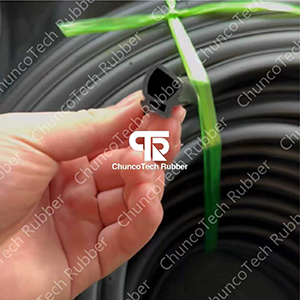


A hydraulic press operating at 35 MPa experienced repeated O-ring failures at the cylinder end-cap after only 200 hours of service. The O-rings were 90 Shore A NBR—the hardest standard compound available. The failure was not insufficient hardness. It was lack of a retaining ring (back-up ring) at the extrusion gap. At 35 MPa, even a 90 Shore A compound will extrude through a 0.2 mm clearance within hours. Wuxi ChuncoTech Rubber supplies O-ring seals in NBR, FKM, EPDM, CR, and Silicone, with hardness from 30 to 90 Shore A, engineered around the principle that pressure capability depends on the retaining ring configuration, not hardness alone.
Technical Core: What Separates a High-Pressure O-Ring from a Standard Sealing Ring
Retaining ring configuration and pressure limits. Without a retaining ring, the maximum pressure for a static O-ring seal is 2 MPa. With a standard retaining ring, it rises to 40 MPa. With a special high-pressure retaining ring, it reaches 200 MPa. A 90 Shore A O-ring without a retaining ring will extrude at pressures far below its material strength limit—the clearance gap is the controlling factor, not the compound hardness.
Hardness and compression set. O-rings range from 30 to 90 Shore A. Softer compounds seal better at low pressure; harder compounds resist extrusion at higher pressure. Low compression set ensures the O-ring maintains sealing force after repeated pressure cycles. A compound that hardens or flattens permanently will leak regardless of its initial hardness.
Dynamic versus static service. Static seals with a retaining ring can handle 40 MPa. Dynamic seals without a retaining ring are limited to 5 MPa. The reciprocating motion in a hydraulic cylinder requires the O-ring to resist both extrusion and wear, and the retaining ring must be sized to the dynamic clearance.

Scenario & Solution: Three Operational Profiles
Scenario 1: Hydraulic Cylinder End-Cap at 35 MPa
Challenge. A hydraulic press cylinder operates at 35 MPa with a 0.2 mm extrusion gap at the end-cap. Standard 90 Shore A NBR O-rings extrude and fail within 200 hours.
Solution. 90 Shore A NBR O-ring with a PTFE retaining ring on the pressure side. The retaining ring bridges the extrusion gap, preventing the O-ring from being forced into the clearance. The O-ring is sized for 15–20% compression at the gland dimensions.
Benefit. Extrusion eliminated, and O-ring life extended from 200 hours to 5,000+ hours. The retaining ring provides the pressure capability that hardness alone cannot deliver.
Scenario 2: High-Temperature Steam Valve at 180°C
Challenge. A steam valve operates at 180°C and 2 MPa. Standard NBR O-rings harden and crack within months, causing steam leaks and safety hazards.
Solution. FKM O-rings rated to 200°C, with 75 Shore A hardness and low compression set. FKM maintains elasticity at steam temperature where NBR hardens and fails.
Benefit. Seal life extended from months to 3+ years. Steam leaks eliminated, and valve maintenance intervals extended. The FKM compound resists the thermal degradation that destroys NBR at 180°C.
Scenario 3: Cryogenic Valve at -196°C
Challenge. A cryogenic valve operates at -196°C with liquid nitrogen. Standard NBR and FKM O-rings become brittle and crack, causing leakage and safety risks.
Solution. Silicone (VMQ) O-rings rated for -60°C to +250°C, with high elasticity at low temperature. The silicone compound maintains flexibility through cryogenic cycling, preventing brittle fracture.
Benefit. Leakage eliminated at cryogenic temperature. The silicone O-ring recovers its shape after each cycle, and the valve maintains sealing integrity through repeated thermal cycling.
Product Range & Selection Guide
ChuncoTech supplies O-rings in NBR, FKM, EPDM, CR, and Silicone, with hardness from 30 to 90 Shore A, in AS568, ISO 3601, or custom dimensions.
| Material | Hardness Range | Temperature Range | Pressure Capability | Recommended Application |
|---|---|---|---|---|
| NBR | 40–90 Shore A | -30°C to +100°C | 2 MPa (no ring), 40 MPa (with ring) | Hydraulic oil, general sealing |
| FKM | 50–90 Shore A | -20°C to +200°C | 2 MPa (no ring), 40 MPa (with ring) | High temperature, chemicals, steam |
| EPDM | 40–85 Shore A | -50°C to +150°C | 2 MPa (no ring), 40 MPa (with ring) | Water, glycol, outdoor |
| CR | 50–80 Shore A | -40°C to +120°C | 2 MPa (no ring), 40 MPa (with ring) | Refrigerants, weather resistance |
| Silicone | 40–75 Shore A | -60°C to +250°C | 2 MPa (no ring), 40 MPa (with ring) | Extreme temperatures, food-grade |
| Configuration | Max Static Pressure | Max Dynamic Pressure | Recommended Application |
|---|---|---|---|
| No retaining ring | 2 MPa | 5 MPa | Low-pressure static and dynamic seals |
| Standard retaining ring | 40 MPa | 20 MPa | General high-pressure hydraulic systems |
| Special retaining ring | 200 MPa | 40 MPa | Ultra-high-pressure hydraulic systems |
Selection steps: Step 1—Confirm the operating pressure, temperature, and fluid. Step 2—Determine the extrusion gap clearance. Step 3—Select the retaining ring configuration based on pressure. Step 4—Select the material and hardness based on temperature and fluid compatibility.

FAQ
Why did my 90 Shore A O-ring still extrude at 35 MPa?
Hardness alone does not prevent extrusion. Without a retaining ring, the O-ring is forced into the clearance gap. Add a PTFE retaining ring on the pressure side.
What is the maximum pressure for an O-ring without a retaining ring?
2 MPa static, 5 MPa dynamic. Above this, a retaining ring is required.
Which material is best for steam service?
FKM for 200°C steam. NBR hardens and cracks above 100°C.
What causes O-ring failure in cryogenic service?
Brittle fracture at low temperature. Silicone (VMQ) maintains flexibility down to -60°C.

Conclusion & CTA
O-ring selection for high-pressure systems requires balancing hardness, retaining ring configuration, and material temperature rating against operating pressure, extrusion gap, and fluid compatibility. The critical variable is not the hardness on the data sheet—it is whether the retaining ring prevents extrusion at the actual pressure and clearance, and whether the compound maintains elasticity at the operating temperature.
To discuss a specific pressure, temperature, or fluid application, contact the engineering team for a seal selection recommendation. Material compatibility data and pressure test reports are available upon request at https://www.chuncotechrubber.com/.