


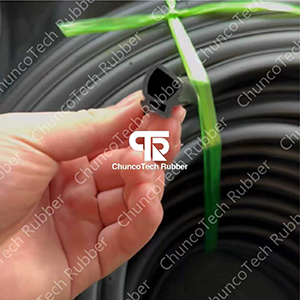

Wuxi ChuncoTech Masters Every Factor That Determines the Quality and Performance of Rubber Seals.
In our last article, “Why the Right O-Ring Starts with the Right Expertise – And Why Wuxi ChuncoTech Delivers Both.”, we explored the critical factors that guide the selection of a reliable O-ring for specific applications. But once the right material is chosen, a more fundamental question emerges: what actually determines whether a rubber seal performs reliably over its intended service life? The answer lies deep within the classification, compounding, and manufacturing process of rubber seals. From the precise formulation of ingredients to the final vulcanization and finishing steps, every stage must be executed with precision to produce seals that meet demanding performance requirements. At Wuxi ChuncoTech Rubber, we combine decades of compounding expertise with advanced manufacturing technology to deliver high-performance rubber seals that consistently meet the most stringent specifications.
Understanding Rubber Seal Classification: Matching Design to Application
Rubber seals are primarily classified by the type of motion they encounter during service. This classification is fundamental because the mechanical demands on a seal—friction, wear, pressure cycling, and deformation—vary dramatically depending on whether surfaces are stationary or moving.
Static Seals operate between two stationary surfaces. Their primary function is to maintain a pressure barrier without any relative motion. Common examples include O-rings used in flange connections, gaskets, and printed seals. The primary challenge for static seals is maintaining compression set resistance over time—the ability to retain elastic recovery after prolonged compression.
Dynamic Seals are further divided based on motion type. Reciprocating seals handle back-and-forth axial motion, such as piston seals and rod seals in hydraulic cylinders. Rotary seals, commonly known as oil seals or radial shaft seals, manage continuous rotational motion around a shaft. Oscillating seals accommodate limited angular motion, often found in swivel joints and certain automotive applications. Each motion type imposes distinct demands on material formulation, hardness, and structural design.
Beyond motion, seals are also classified by sealing mechanism: radial seals (like O-rings in a bore or on a shaft) and face seals (where sealing occurs between perpendicular surfaces). Understanding these classifications is essential for selecting or designing the right custom rubber seal for any application.

The Compounding Challenge: Formulating for Performance
The journey of a rubber seal begins not in a mold, but in the laboratory, where raw rubber polymers are combined with a precise blend of ingredients. Rubber compounding is a complex science that determines virtually every performance characteristic of the finished seal.
Polymer selection establishes the baseline properties. Nitrile rubber (NBR) dominates oil-resistant applications. EPDM excels in weather-resistant and coolant systems. Fluorocarbon rubber (FKM) handles extreme heat and aggressive chemicals. Silicone (VMQ) provides unmatched low-temperature flexibility and food-grade safety.
But the polymer alone is insufficient. Curing systems determine how the rubber crosslinks during vulcanization. For seals requiring low compression set—a critical requirement for O-rings and gaskets—peroxide curing systems or efficient sulfur systems (low sulfur with high accelerator levels) produce more stable crosslinks than conventional sulfur systems. Fillers and reinforcing agents, such as various grades of carbon black or silica, control hardness, tensile strength, and abrasion resistance. Processing aids and plasticizers affect flow characteristics during molding and low-temperature flexibility in service.
At Wuxi ChuncoTech Rubber, we maintain strict control over every compound we develop. Our custom rubber compounding capabilities allow us to formulate materials precisely matched to application requirements—whether that means extreme temperature resistance, chemical compatibility, or exceptional dynamic performance.

Mixing and Preforming: Building the Foundation
Once the formulation is established, the ingredients must be uniformly dispersed. Mixing—whether using an internal mixer (Banbury) or an open mill—must achieve homogeneous distribution of all components. Insufficient mixing leads to inconsistent physical properties, poor cure uniformity, and premature seal failure. For high-quality seals, the mixed compound is often strained or filtered to remove any undispersed particles, foreign matter, or agglomerates that could create leak paths.
Preforming prepares the rubber for molding. Accurate preform weight is essential to ensure complete cavity fill without excessive flash. For large-scale production, advanced automated preformers deliver precisely weighed blanks. In high-volume O-ring manufacturing, injection molding or transfer molding with multi-cavity tools dramatically increases productivity while maintaining dimensional consistency.
Vulcanization and Finishing: Precision in the Mold
Vulcanization transforms the rubber compound from a plastic, flowable material into a durable, elastic seal. Temperature, pressure, and time must be precisely controlled to achieve optimal crosslink density without degradation. Modern high-temperature, short-cycle curing formulations enable rapid production while maintaining excellent physical properties.
For complex seals like oil seals with metal cases and springs, additional steps are required. Bonding agents ensure reliable adhesion between rubber and metal. Surface treatments—such as halogenation or PTFE coating—may be applied to reduce friction or improve wear resistance for demanding dynamic applications.
Finishing has evolved dramatically. Traditional hand-trimming of flash has given way to cryogenic deflashing, mechanical trimming, and automated laser trimming systems that deliver consistent dimensions, clean edges, and tight tolerances. For high-volume O-rings, flashless molding techniques eliminate secondary finishing entirely.

Quality Control: The Final Assurance
No matter how well formulated or precisely molded, a rubber seal is only as good as its final inspection. Dimensional verification ensures that every seal meets specified tolerances. Hardness testing, tensile testing, and compression set measurement confirm that the cured rubber meets performance specifications. For critical applications, leak testing under simulated operating conditions validates sealing integrity before shipment.
Why Expertise Matters: The Cost of Compromise
Inferior seals often fail not because of a single catastrophic error, but because of accumulated compromises throughout the manufacturing process: inconsistent mixing, imprecise preforming, poorly controlled curing, or inadequate finishing. The result—leaks, equipment downtime, and safety risks—far outweighs the initial cost savings.
At Wuxi ChuncoTech Rubber, we take a holistic approach to seal manufacturing. Our expertise spans rubber compounding, precision molding, post-processing, and rigorous quality control. Whether you need static O-rings, dynamic hydraulic seals, rotary shaft oil seals, or custom-molded gaskets, we deliver products engineered for reliability.
Your Partner in Rubber Sealing Solutions
To learn more about our custom rubber seal manufacturing capabilities, explore our standard product offerings, or discuss a specific application, visit our website at https://www.chuncotechrubber.com/. Let Wuxi ChuncoTech Rubber bring precision, consistency, and expertise to your sealing challenges.