




What Should You Consider When Buying D-Type Rubber Fenders for Marine Applications?

Choosing the right D-Type Rubber Fender depends on a few critical factors. You must weigh material quality, sizing, performance ratings, installation stability, environmental resistance, maintenance needs, and total cost. These fenders suit smaller vessels, dock edges, and ship-to-ship work. The global marine fender market reached USD 460.0 million in 2025, so your choice matters.
Key Takeaways
Material and Construction Quality

The material you choose determines how long your fender lasts and how well it protects your vessel. Two common options exist: marine-grade rubber and marine-grade flexible PVC. Rubber compounds offer superior elasticity and rebound. They absorb impact energy and return to shape without cracking. Flexible PVC costs less upfront. It works for light-duty applications with minimal impact. For demanding marine environments, rubber remains the preferred choice for a D-Type Rubber Fender.
Rubber Compound and Steel Inserts
Rubber compound quality varies significantly across suppliers. EPDM rubber stands out for marine applications. Its saturated polymer main chain has no double bonds, so it resists ozone attack. This molecular structure gives EPDM superior UV and ozone resistance, described as the best of any standard elastomer. You will find EPDM recommended for above-deck marine components such as hatch seals, portlights, and water-system gaskets. One limitation matters: EPDM is not rated for oil contact. It swells in petroleum oil, so avoid it in engine rooms or bilge areas.
Steel inserts add structural strength to rubber fenders. Manufacturers compression-mold these inserts directly into the rubber body. This process bonds the steel and rubber into a single unit. The insert prevents the fender from stretching or deforming under repeated impact. It also provides a secure anchor point for mounting bolts. Without steel reinforcement, rubber fenders can tear away from their mounting surface during heavy berthing.
Durability in Saltwater and Sunlight
Marine environments punish inferior materials. Saltwater corrodes metal components. UV radiation breaks down polymer chains. Temperature swings cause expansion and contraction. Your fender must withstand all three threats simultaneously.
EPDM handles these conditions well. It keeps its mechanical properties in outdoor marine environments for 20–30 years. This longevity comes from its stable molecular structure. The material resists hardening, cracking, and surface degradation. You will find EPDM used in foam-filled fenders and plate or strip-type fenders specifically for weather resistance.
Other rubber compounds may offer adequate performance at lower cost. Nitrile rubber resists oil but offers less UV protection. Neoprene balances oil resistance with moderate weather resistance. Your operating environment determines the best choice. For general dock and vessel protection exposed to sunlight and saltwater, EPDM provides reliable long-term service.
Sizing a D-Type Rubber Fender Correctly
You cannot pick a fender by guesswork. The size must match your vessel and berth. Three numbers drive the decision: vessel weight, impact force, and berthing speed.
Vessel Weight, Impact Force, and Berthing Speed
Start with your vessel's displacement in tonnes. This value is the mass (M) in the standard berthing energy formula: E = 0.5 × Cm × M × Vb² × Ce × Cc × Cs. Required energy absorption rises proportionally with tonnage. A heavier ship always demands a larger fender section.
Berthing speed matters more. The Vb² term means you square the approach velocity. Doubling speed quadruples berthing energy. Your fender must absorb that spike.
The table below shows how energy absorption climbs across the D-type range at 50% deflection:
|
D-fender Size (mm) |
Energy Absorption (kN·m) |
|---|---|
|
D150 × 150 |
~3.2 |
|
D200 × 200 |
~8.6 |
|
D250 × 250 |
~9.2 |
|
D300 × 300 |
~12.0 |
|
D300 × 360 |
~14.3 |
|
D400 × 400 |
~20.0 |
|
D500 × 500 |
~32.0 |
The D500 absorbs roughly ten times the energy of a D150. Match the section to the vessel, not to the dock's appearance.
D fenders are cost-effective for low-to-medium-energy berthing; cone/cell/pneumatic take over when vessel deadweight, approach speed, or angular berthing demands low reaction force and high energy absorption. Putting D fenders on a berth that sees large displacement, high approach speed, or frequent heavy contact is dangerous — that is where you step up to arch, W, cell, cone, or pneumatic systems.
Matching Dimensions to Dock and Hull
D-type fenders suit smaller quays, wharves, and vessels. Their flat-back, compact design makes installation easy on piers and frame docks. Tugboats, inland vessels, and small ships benefit most. Large vessels generate energy beyond the D-family range.
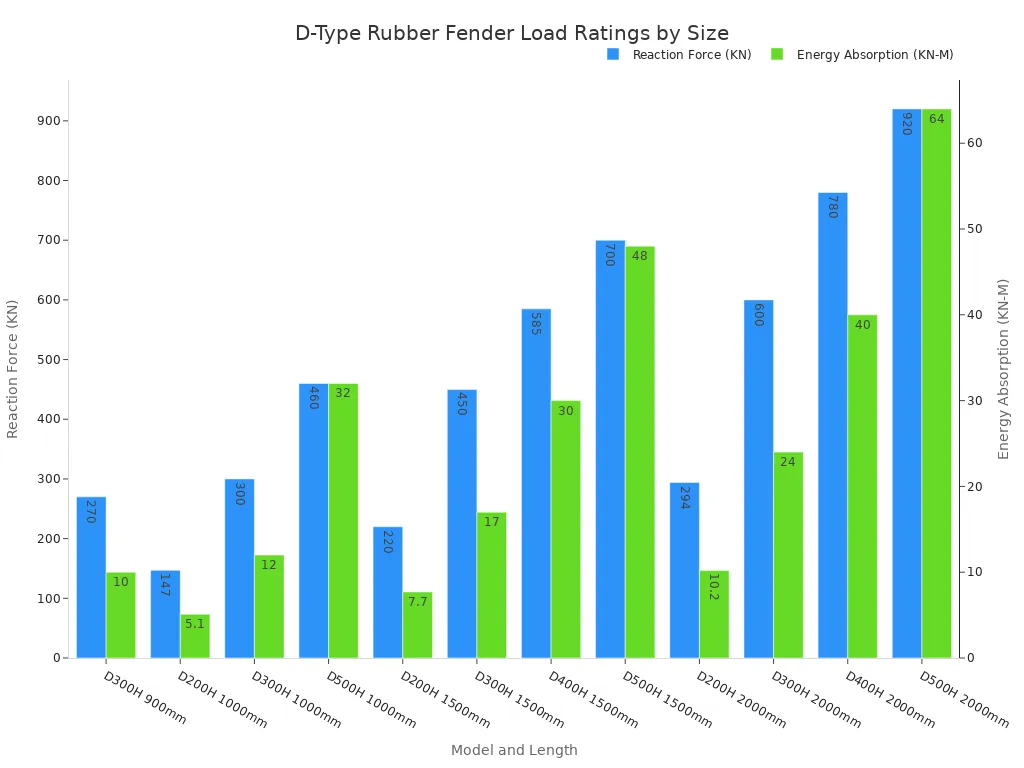
Standard units carry rated performance at 50% deflection. The chart below compares common models:
Spacing determines whether the hull touches the quay wall. Follow two rules when you position fenders:
This prevents hull contact between units and stops heat buckling.
For wall-type wharves, rubber fenders should be arranged at equal intervals, generally 5–20 m, to prevent the ship from directly colliding with the quay wall after fender compression.
A D-Type Rubber Fender works only when its dimensions match the vessel and the dock face. Confirm berthing speed and displacement, then check reaction force at 50% deflection. These numbers tell you if a D-type stays within its safe range. Choose a different fender system when required energy exceeds D-family ratings.
Performance, Installation, and Cost
Energy Absorption and Low Reaction Force
A D-Type Rubber Fender absorbs impact energy through controlled deflection. The rubber body compresses under load and returns to its original shape. D-type fenders deliver high energy absorption with medium to high reaction force. W-type fenders offer ultra-high energy absorption with low to medium reaction force.
|
Fender Type |
Energy Absorption |
Reaction Force |
|---|---|---|
|
D-Type Rubber Fender |
High |
Medium to High |
|
W-Type Rubber Fender |
Ultra-High |
Low to Medium |
Low reaction force matters for ship-to-ship operations. A soft reaction force reduces stress on both hulls during contact. D-type fenders work well in these scenarios when vessel size and berthing speed stay within their rated range. You should match the fender's reaction force to your hull's design limits. Exceeding those limits risks structural damage.
Mounting Stability, Maintenance, and Value
Installation is straightforward on various surfaces. The flat-back design mounts easily on concrete, steel, and timber. Steel inserts provide secure anchoring and prevent deformation under repeated impact. This stability keeps the fender aligned with the dock face over time.
You should inspect rubber fenders at least once every month. Check for cracks, cuts, wear signs, rusted or loose mounting hardware, and verify proper alignment and coverage.
|
Condition |
Recommended Action |
|---|---|
|
Small crack |
Patch using a repair kit |
|
Deep cut |
Replace the fender |
|
Missing piece |
Replace the fender |
|
Rusty hardware |
Replace bolts or chains |
|
Air leak (pneumatic) |
Repair or replace the fender |
D-type fenders are designed to protect piers and wharves, which are typical structures on commercial docks.
Balance price against service life when you evaluate cost. A cheaper fender that fails early costs more in replacement and downtime. Quality rubber compounds and proper sizing extend service life and deliver better long-term value.
Material quality, correct sizing, performance ratings, and installation stability all shape your D-Type Rubber Fender choice. Environmental durability, maintenance routines, and total cost matter too. Prioritize these factors. You prevent costly damage and extend fender life.
Consult a supplier with your vessel weight and berth details. Request a quote tailored to your needs.
FAQ
Which rubber compound works best for saltwater and sunlight exposure?
EPDM rubber resists UV radiation, ozone, and saltwater for 20–30 years. Avoid EPDM near oil or fuel. Nitrile and neoprene offer oil resistance with less weather protection.
How do you confirm a D-type fender fits your vessel?
Check your vessel's displacement and berthing speed. Calculate required energy absorption. Compare that number against the D-family ratings at 50% deflection. Choose another fender type when energy demands exceed D-series limits.
How often should you inspect rubber fenders?
Inspect at least once every month. Look for cracks, cuts, wear, and rusted hardware. Patch small cracks with a repair kit. Replace fenders with deep cuts or missing pieces.