


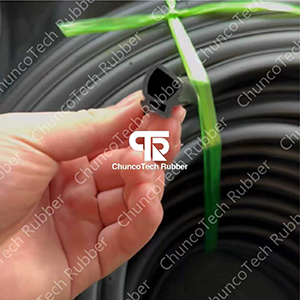


Wuxi ChuncoTech's Products Are Denser and Bubble-Free – Thanks to Our Deep Expertise in Mold Venting
Following our deep dive into 《Wuxi ChuncoTech Provides Optimal Matching Solutions for Different Vessels》, we established that selecting the right geometry is crucial for performance. However, even the most perfectly designed fender is worthless if its manufacturing is flawed. The true test of quality lies not in the drawing, but in the vulcanization process. This is where raw rubber compounds are transformed into durable, life-saving products. And this is also where the most frustrating enemies of quality emerge: air bubbles and incompletely filled cavities. If you've ever watched a seemingly perfect part emerge from the press only to find a hidden void or a missing edge, you know the frustration. Today, we pull back the curtain on the "Art of Mold Venting"—a critical discipline that separates world-class manufacturing from scrap-filled reject bins.
Why Are Your Rubber Parts Still Full of Air Bubbles? Mastering the Art of Mold Venting
Every hiss of a press opening carries either satisfaction or disappointment. For many shop floor operators, the moment of truth reveals the same old enemies: a blister marring the surface, or an unfilled corner—what we call a "short shot" or "unfilled area." The instinctive reaction is often to add more pressure, extend the curing time, or bump the mold a few extra times. While these actions can sometimes help, they treat the symptom, not the disease. At Wuxi ChuncoTech Rubber, we understand that both bubbles and short shots share a common root cause: trapped air occupying space that should be filled by rubber. Mastering how to eliminate this trapped air is the cornerstone of producing high-quality rubber molded products.
Know Your Enemy: Where Does the Trapped Air Come From?
To win the battle against defects, you must first understand the origin of the gas. In rubber compression molding, the culprits are typically threefold. First, and most significantly, is the ambient air inside the mold cavity itself. As the mold closes, this air must escape. If the rubber flows faster than the air can evacuate, the air becomes encapsulated. Second, there is air entrapped within the rubber compound itself, introduced during milling or extrusion if the prep work is careless. Finally, there are volatiles and moisture. Under the intense heat of vulcanization, residual moisture or low-boiling-point components in the formulation vaporize, expanding dramatically and creating internal pressure.
The critical distinction between bubbles and short shots is simply where the gas ends up. If the gas is trapped inside the rubber, it creates a bubble or blister. If the gas is forced into a dead end of the mold, creating back-pressure that prevents the rubber from flowing into that corner, the result is a short shot or unfilled cavity.

The First Line of Defense: Mold Design and Venting Channels
The battle for perfect parts is won or lost at the design stage. The mold itself is your primary tool for evacuation. The venting groove design is not an afterthought; it is a precision-engineered pathway. The dilemma is classic: grooves too shallow get blocked instantly by a thin layer of rubber flash, rendering them useless. Grooves too deep allow rubber to escape, creating thick, unsightly flash and potentially reducing cavity pressure, which compromises the density of the final product.
The solution lies in precision. For most applications, the depth of venting grooves on the parting line should be meticulously controlled between 0.02mm and 0.05mm. The section closest to the cavity must be shallow to prevent rubber penetration, while the outer sections can gradually deepen to allow rapid gas escape. For complex geometries, relying solely on the parting line is insufficient. This is where venting inserts or pins come into play. By utilizing the microscopic clearance of 0.01mm to 0.03mm between metal components, you create dedicated escape routes for air in blind holes or dead zones—areas where rubber viscosity prevents it from following the air through. However, these tiny channels are vulnerable. If you suddenly encounter bubbles where none existed before, the first suspect should always be blocked vents. Regular mold cleaning is non-negotiable.

The Human Element: Bumping Technique and Material Placement
A perfect mold can be sabotaged by poor technique. The most common manual intervention is bumping, or "crack opening"—the act of briefly lifting the press to allow gas to escape. But timing is everything. Bumping must occur precisely when the rubber has begun to flow under heat but before the vulcanization reaction (scorch) has started. If you bump too late, a skin has already formed on the rubber surface. Lifting the mold at this point doesn't release internal gas; it can actually suck outside air back in or tear the partially cured surface, creating a new defect.
The protocol matters: perform 2-3 short, rapid bumps immediately after initial closure. The lift should be minimal—just enough to flash the parting line, not to fully separate the mold halves. Even more critical, and often overlooked, is prep placement. Throwing a chunk of rubber haphazardly into the cavity is a recipe for disaster. The worst practice is placing a flat pad of rubber larger than the cavity directly onto the mold. As the press closes, the edges seal first, trapping air in the center—a guaranteed bubble.
The correct philosophy is what we call the "High Center, Not Full Perimeter" rule. The rubber preform shape should mimic the final product's contour as closely as possible and be positioned centrally. This ensures that as the mold closes, the rubber flows radially from the center outwards, pushing air ahead of it like a squeegee towards the venting grooves on the parting line.

Material Science: The Role of Compound and Mixing
Venting isn't solely a mechanical or manual challenge; it begins in the chemistry of the rubber compound. If your raw material is saturated with moisture, the game is lost before it begins. At typical vulcanization temperatures of 180°C, absorbed water flashes instantly into steam, expanding over a thousandfold. No venting system can cope with that. Therefore, moisture control is paramount. Storage conditions matter, and hygroscopic fillers like silica or precipitated calcium carbonate should ideally be dried before use. For critical applications, adding a small amount of calcium oxide (CaO) as a moisture scavenger can be transformative.
Furthermore, the flowability of the compound, often indicated by its Mooney viscosity, directly impacts venting. If the viscosity is too high, the rubber moves like a stone, failing to fill intricate details before the cure sets in, leading to short shots. Conversely, if the viscosity is too low, the rubber flows so fast that it can seal the venting grooves prematurely with flash, trapping air inside the cavity. Maintaining batch-to-batch consistency in Mooney viscosity is essential. For exceptionally complex parts, incorporating flow improvers or adjusting the plasticizer system can provide the precise flow characteristics needed for flawless filling.
The Ultimate Weapon: Vacuum Vulcanizing Presses
Sometimes, despite perfect molds, skilled operators, and optimized compounds, conventional venting reaches its limits. This is true for parts with deep, blind holes, intricate undercuts, or when the surface finish requirements are absolute, such as in medical-grade or food-grade silicone products. In these scenarios, the only reliable solution is the vacuum vulcanizing press. This advanced equipment encloses the entire mold in a vacuum chamber before and during closure. By evacuating the air before the rubber flows, you eliminate the root cause entirely. The capital investment is higher, but for eliminating persistent bubbles and short shots in complex molds, it represents a decisive technological advantage.
At Wuxi ChuncoTech Rubber, we don't just mold rubber; we master the art of venting. From the initial design of our molds with precision-engineered channels to the rigorous training of our operators in material placement and bumping techniques, and our strategic use of vacuum technology, we ensure that every product that leaves our press is dense, void-free, and dimensionally accurate. We understand that our reputation rests on the reliability of every single part we produce.
Don't let trapped air compromise your critical components. Visit our website at https://www.chuncotechrubber.com/ to discover how our manufacturing expertise delivers flawless rubber products, engineered for your most demanding applications.